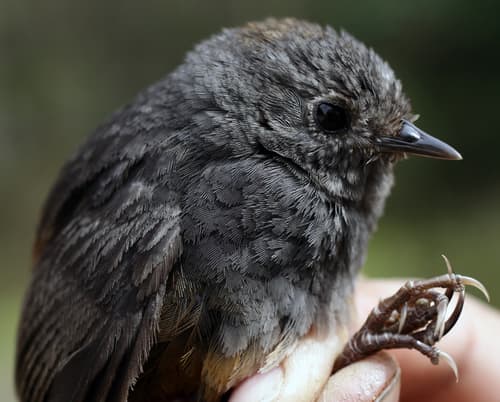
Locally fairly common by voice but, like all Scytalopus, hard to see; range-restricted endemic of the Serrania del Perija. Described only in 2015. Far more often heard than seen.
Field marks
Small dark tapaculo, body 10-12 cm, tail ~4 cm. Adults neutral gray head, brownish neck, brown-sepia streaked back, and grayish-white throat, breast and belly; males show some buff on the breast and less distinct brown nape spotting than females (females browner/more barred on flanks and nape). Best identified by voice, range and elevation rather than plumage.
Habitat
Dense undergrowth, bamboo, mossy tangles and the forest floor of humid montane and elfin forest; 1,600-3,225 m on the Perija slopes.
Behavior
Skulks mouse-like on or near the ground in the densest cover; runs through root tangles and leaf litter; rarely flies and seldom shows in the open. Located and identified by song; will sometimes approach a soft whistled imitation or playback.
Voice
Typical song a very long series of rising, fast frog-like trills (churring/trilled notes); also gives sharp scolding call notes. Diagnostic vs neighboring taxa. Search Xeno-canto / Macaulay Library under 'Scytalopus perijanus' or 'Perija Tapaculo'.
Caracas Tapaculo / Merida Tapaculo (Scytalopus caracae, S. meridanus) and Spillmann's/latebricola group - vocally and genetically distinct; in the Perija, range plus the long rising frog-like trill confirm perijanus
Sympatric overlap with other Scytalopus is minimal in the Venezuelan Perija; treat any Scytalopus there as this species pending vocal confirmation
Guide note
Get clients on the song first, then use short, sparing playback at a dense edge and have everyone watch a single low gap - it will dart across briefly. Manage expectations: a clean look is a real achievement, so prioritize hearing the diagnostic rising trill and a glimpse over a prolonged stakeout.