Locally common in the open Gran Sabana grasslands but patchy and somewhat nomadic, tracking grass seeding; numbers and presence at a given site vary seasonally. A grassland specialty rather than a true forest tepui endemic — note the category here treats the Gran Sabana populations as a regional specialty.
Field marks
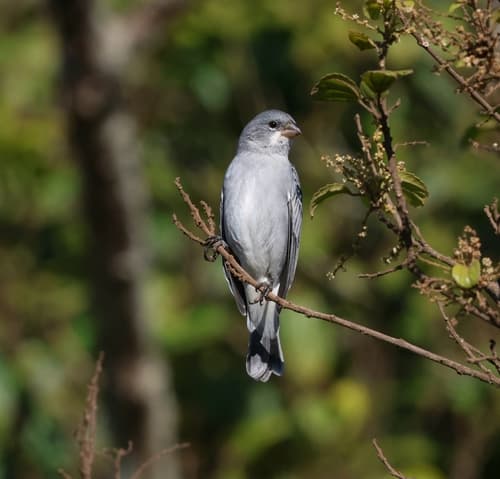
Small, stub-billed seedeater. Male mostly plain blue-gray with a white chin/throat patch and a small white speculum (wing spot) and white central belly; bill often pale/bluish. Female and immatures olive-brown above, buff below, lacking the white wing spot — drab and easily overlooked. The clean gray male with white throat and tiny wing spot is the key.
Habitat
Tall mature savanna grassland and open campos, often near water; in the tepui region this is the Gran Sabana open country rather than forest.
Behavior
Forages on the ground and clings to grass stems eating seeds (notably Andropogon grasses); solitary, in small groups, or in mixed seedeater/finch flocks. Males sing from exposed grass-top perches.
Voice
Male gives a sweet, varied, somewhat musical warbling song delivered from a grass-stem or low perch; short call notes. Search Xeno-canto and Macaulay Library for 'Plumbeous Seedeater' (eBird/ML code plusee1).
Other Sporophila and grassland finches in the Gran Sabana — separate the male by uniform blue-gray plumage, white throat and small white wing speculum; bill color helps.
Females are very difficult — note structure, range and association with singing males rather than attempting a plumage-only ID.
Guide note
Scan grass-top perches for singing males rather than hunting silent females. Treat it as a Gran Sabana grassland bonus while moving between forest tepui sites — flag for trainees that it is a savanna specialty, not a slope-forest endemic, so they don't over-claim it as 'tepui forest.'